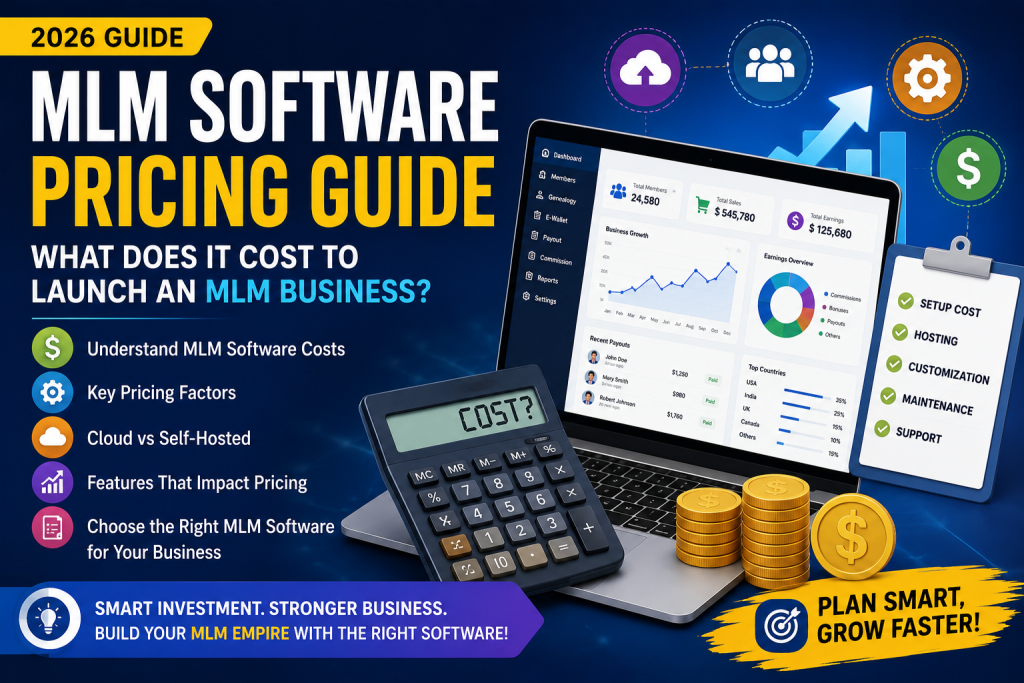

MLM Software Pricing Guide (2026): What Does It Cost to Launch an MLM Business?

MLM Software Pricing Guide 2026

Launching a successful network marketing business requires more than an excellent compensation plan and quality products. One of the most important investments is choosing the right MLM software to automate distributor management, commission calculations, genealogy tracking, e-commerce, and reporting.

One of the first questions entrepreneurs ask is:

How much does MLM software cost?

The answer depends on several factors, including the number of users, required features, customization, hosting model, integrations, and long-term support.

In this comprehensive pricing guide, you’ll learn:

  • How much MLM software costs in 2026
  • Different pricing models
  • Hidden expenses to avoid
  • Cloud vs self-hosted pricing
  • Factors that influence cost
  • How to choose affordable MLM software
  • Why Hybrid MLM Software offers excellent value for businesses of all sizes

Why MLM Software Is a Smart Investment

Managing an MLM business manually becomes increasingly difficult as your distributor network grows. Modern MLM software helps automate daily operations, reducing errors and saving valuable time.

With a reliable platform, businesses can:

  • Automate commission calculations
  • Manage genealogy trees
  • Track distributor performance
  • Process payouts securely
  • Integrate with e-commerce stores
  • Generate detailed reports
  • Support multiple languages and currencies
  • Scale operations globally

Instead of hiring a large administrative team, businesses can automate most repetitive tasks, improving efficiency and accuracy.

How Much Does MLM Software Cost?

There is no single fixed price because every business has different requirements. However, most MLM software providers offer one of the following pricing models.

1. One-Time License

This model allows you to purchase the software once and host it on your own server.

Best For

  • Startups
  • Small businesses
  • Companies wanting full ownership


Advantages

  • One-time investment
  • Full control over data
  • No recurring software subscription
  • Customizable platform

2. Cloud-Based Subscription (SaaS)

The provider hosts the software, and customers pay a monthly or yearly subscription.

Best For

  • Businesses without IT infrastructure
  • Quick deployment
  • Growing companies


Advantages

  • Automatic updates
  • Managed hosting
  • Reduced maintenance
  • Lower upfront investment

3. Custom Enterprise Solution

Large organizations often require highly customized systems.

Pricing depends on:

  • Custom development
  • API integrations
  • Multiple compensation plans
  • High-performance infrastructure
  • Advanced security
  • White-label branding

Enterprise projects generally involve higher implementation costs because of their complexity.

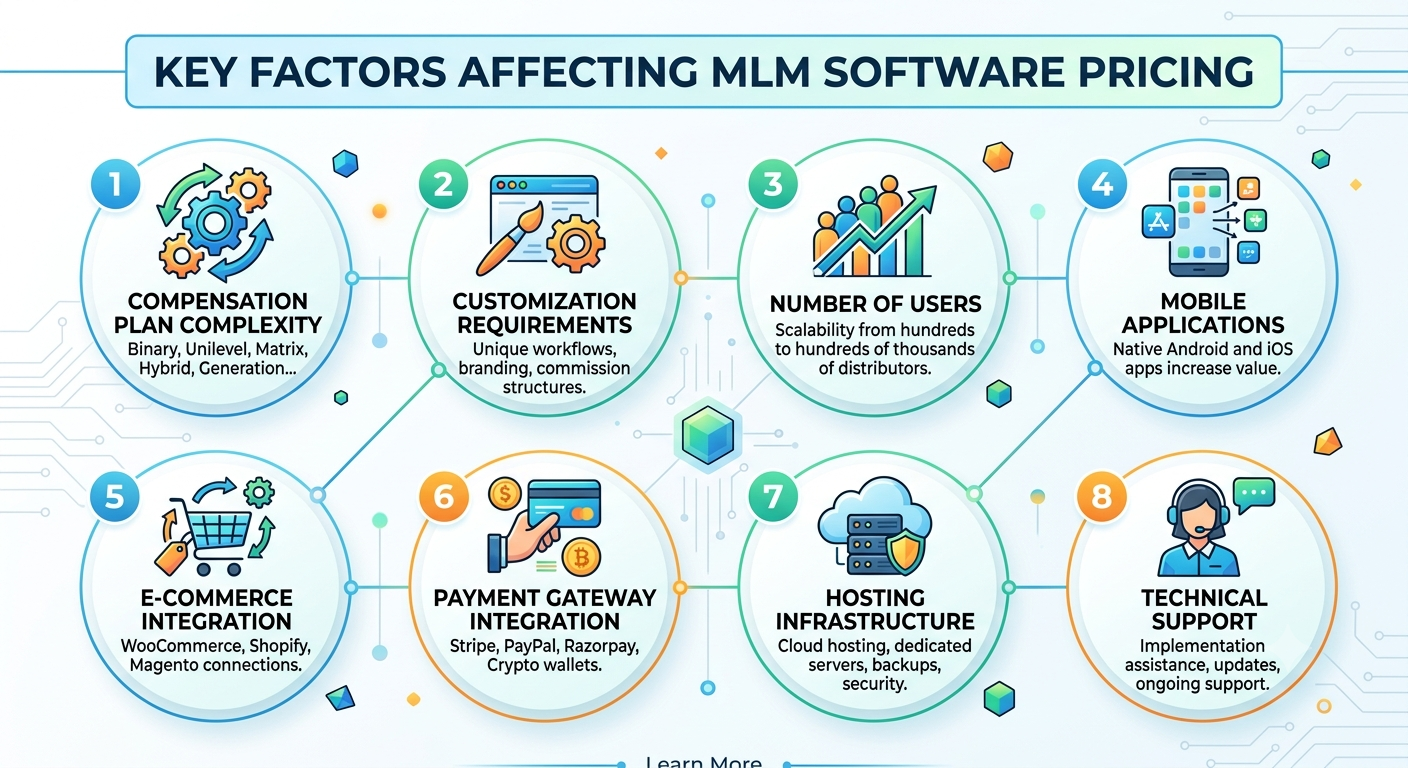
Several elements influence the final price of an MLM software solution.

What Factors Affect MLM Software Pricing

Compensation Plan Complexity

Supporting multiple plans such as Binary, Unilevel, Matrix, Hybrid, Generation, ROI, or Board plans increases development complexity.

Customization Requirements

Every business has unique workflows, branding, and commission structures. More customization generally increases implementation time and cost.

Number of Users

A platform designed for a few hundred users differs significantly from one supporting hundreds of thousands of distributors.

Mobile Applications

Native Android and iOS apps add value but may also affect the overall investment.

E-Commerce Integration

Connecting with WooCommerce, Shopify, Magento, or custom online stores may require additional configuration.

Payment Gateway Integration

Support for payment gateways such as Stripe, PayPal, Razorpay, bank transfers, or cryptocurrency wallets may influence pricing depending on the number and type of integrations.

Hosting Infrastructure

Cloud hosting, dedicated servers, backups, and security services all contribute to operational costs.

Technical Support

Some providers include implementation assistance, software updates, and ongoing support, while others charge separately.

Hidden Costs to Consider

When comparing providers, look beyond the initial purchase price.

Potential additional expenses include:

  • Custom development
  • Third-party integrations
  • Server hosting
  • Domain and SSL certificates
  • SMS gateway fees
  • Email service costs
  • Payment gateway transaction fees
  • Mobile app publishing
  • Training and onboarding
  • Annual maintenance

Choosing a transparent provider helps avoid unexpected costs later.

Cloud-Based vs Self-Hosted MLM Software

Feature Cloud-Based Self-Hosted
Upfront Investment Lower Higher
Deployment Speed Fast Moderate
Data Control Provider-managed Business-owned
Maintenance Included Customer-managed
Automatic Updates Yes Manual or scheduled
Scalability High Depends on infrastructure
Best For Startups and growing businesses Businesses needing complete control

Essential Features Worth Paying For

When evaluating software, prioritize long-term value rather than choosing solely on price.

A quality MLM software platform should include:

Member Management

  • Distributor registration
  • Profile management
  • KYC verification

Genealogy Management

  • Binary Tree
  • Sponsor Tree
  • Matrix Tree
  • Unilevel Tree

Commission Engine

  • Referral bonuses
  • Matching bonuses
  • Pairing bonuses
  • Rank incentives
  • Leadership rewards

E-Wallet

  • Fund transfers
  • Withdrawal requests
  • Wallet history

Payment Integration

  • Multiple payment gateways
  • Cryptocurrency support
  • Bank transfers

Mobile Apps

  • Android application
  • iOS application
  • Admin dashboard

E-Commerce

  • WooCommerce integration
  • Shopify integration
  • Product management
  • Shopping cart

Reports

  • Income reports
  • Sales reports
  • Commission reports
  • Tax reports
  • Member analytics

Security

  • SSL encryption
  • Two-factor authentication
  • Data backups
  • Role-based access control

How to Choose Affordable MLM Software

Affordable software is not simply the cheapest option—it is the one that delivers the best value for your investment.

Consider these factors:

  • Feature completeness
  • Ease of use
  • Scalability
  • Security
  • Customer support
  • Customization options
  • Mobile accessibility
  • Transparent pricing
  • Long-term upgrade path

A solution that grows with your business can reduce future migration costs.

Why Hybrid MLM Software Is an Affordable Choice

When comparing cost, features, and scalability, Hybrid MLM Software stands out as a strong option for businesses ranging from startups to large enterprises.

The platform is designed to provide a comprehensive feature set without requiring businesses to purchase multiple separate systems.

Key Advantages

  • Supports multiple MLM compensation plans
  • Affordable licensing options
  • Suitable for startups, SMEs, and enterprise businesses
  • Cloud-based and self-hosted deployment
  • Android and iOS mobile apps
  • Multi-language and multi-currency support
  • Automated commission engine
  • Advanced genealogy management
  • E-commerce integrations
  • CRM and marketing tools
  • AI-powered reports and analytics
  • Secure payment gateway integrations
  • Customization based on business requirements
  • Scalable infrastructure for future growth
  • Regular software updates and technical support

By investing in a scalable platform from the beginning, businesses can avoid the cost and disruption of switching systems as they grow.

Common Mistakes When Buying MLM Software

Avoid these common pitfalls:

  • Choosing software based only on price
  • Ignoring scalability
  • Overlooking security features
  • Selecting a provider with limited support
  • Failing to verify customization capabilities
  • Not checking mobile app availability
  • Underestimating integration needs
  • Overlooking future expansion plans

A careful evaluation today can save significant time and money later.

Frequently Asked Questions (FAQs)

How much does MLM software usually cost?

Pricing varies based on features, deployment model, customization, and business size. Some providers offer one-time licenses, while others use monthly or annual subscriptions.

Cloud solutions often have lower upfront costs because hosting and maintenance are managed by the provider. However, long-term costs depend on the subscription model.

Most packages include distributor management, genealogy, commission calculations, reporting, and administration. Additional modules, integrations, or customizations may affect the total cost.

Yes. A scalable platform can support businesses from startup stage to enterprise operations, provided it offers the necessary performance, security, and customization.

Hybrid MLM Software combines affordability with a comprehensive set of features, including support for multiple compensation plans, mobile applications, e-commerce integration, advanced reporting, and scalable deployment options. It is designed to support businesses at every stage of growth.

Conclusion

Choosing MLM software is a long-term business decision rather than simply a purchase. While pricing varies depending on your requirements, the most important consideration is the overall value the platform provides.

A reliable MLM software solution should automate daily operations, reduce manual work, support business growth, and deliver a seamless experience for both administrators and distributors.

For businesses seeking an affordable, scalable, and feature-rich solution, Hybrid MLM Software offers a balanced combination of functionality, flexibility, and long-term value. Whether you’re launching a startup or managing a global network marketing organization, investing in the right software can help streamline operations and support sustainable business growth.

Buy-mlm-software-getstarted-24*7-support

Ready to Get started ?

Powerful, flexible MLM software with over 350+ modules Built on cutting-edge tech and powered by our HybridV9™ Engine for fast, scalable commission processing.

You may also interested in