
Multi-Level Marketing (MLM), also known as network marketing, is a business model in which products or services are marketed through a network of independent distributors or representatives. Instead of depending only on traditional retail channels, an MLM business can combine direct product sales, customer relationships, distributor development, and team-based sales activity.
But having an MLM compensation plan or recruiting distributors alone does not create a strong MLM business.
A sustainable network marketing organization needs several important foundations working together.
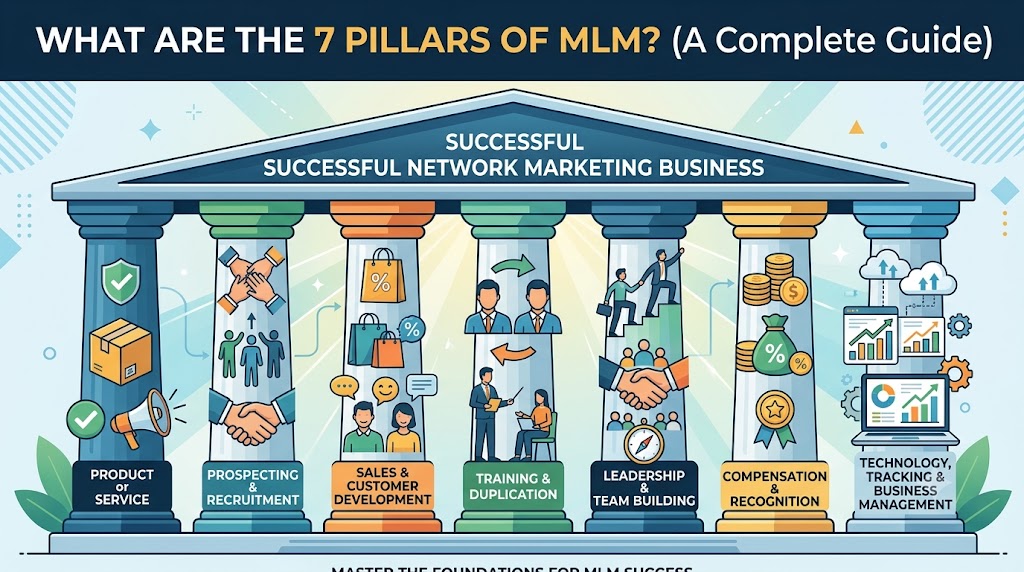
These foundations can be understood as the 7 pillars of MLM:
- Product or Service
- Prospecting and Recruitment
- Sales and Customer Development
- Training and Duplication
- Leadership and Team Building
- Compensation and Recognition
- Technology, Tracking and Business Management
These seven pillars provide a practical framework for understanding how an MLM organization can attract people, sell products, develop distributors, manage performance, and scale its operations.
It is also important to distinguish sustainable MLM practices from recruitment-focused schemes. The U.S. Federal Trade Commission notes that MLM structures vary, but consumer-protection principles apply across the industry. It also warns that earnings claims must be truthful, substantiated, and representative rather than based on exceptional individual results.
The 7 Pillars of MLM
1. Product or Service: The Foundation of the MLM Business
The first and most important pillar is the product or service.
An MLM company needs something valuable that customers actually want to purchase. Without a competitive product or service, recruitment alone cannot create a sustainable customer-based business.
A strong MLM product should ideally provide:
- Genuine customer value
- Competitive pricing
- Consistent quality
- Clear benefits
- Reliable availability
- Repeat-purchase potential where appropriate
- Strong customer support
- Compliance with applicable product and advertising laws
Table of Contents
ToggleWhy Products Matter in MLM
A product-centered business gives distributors something meaningful to demonstrate, recommend, and sell.
For example, depending on the industry, an MLM company could offer:
- Beauty and personal-care products
- Health and wellness products
- Household products
- Educational services
- Digital products
- Subscription services
- Technology products
- Financial or business services where legally appropriate
The key principle is simple:
The business should create real customer value, not rely primarily on recruitment.
The FTC specifically advises consumers to examine the products offered by an MLM and be cautious of products with questionable benefits or unsupported claims.
How MLM Software Supports This Pillar
Modern MLM software can connect product sales with distributor accounts, orders, commissions, inventory information, customer records, and reports.
This creates better visibility into:
- Product sales
- Distributor orders
- Customer purchases
- Sales volume
- Team performance
- Commission qualification
2. Prospecting and Recruitment: Building the Network
The second pillar is prospecting and recruitment.
An MLM organization needs a process for finding potential customers and potential distributors. Prospecting involves identifying people who may genuinely be interested in the product, service, or business opportunity.
Traditional prospecting may include:
- Personal referrals
- Customer referrals
- Events
- Product demonstrations
- Networking
- Social media
- Content marketing
- Email marketing
- Websites and landing pages
- Community engagement
Modern network marketing has expanded far beyond face-to-face meetings.
Distributors can now use digital channels to educate prospects, share product information, follow up with customers, and manage relationships.
Recruitment Should Be Responsible
Recruitment is an important part of many MLM structures, but recruitment should not become the only objective.
A healthy MLM organization should focus on:
Customers → Product Sales → Distributor Development → Team Sales
rather than simply:
Recruit → Recruit → Recruit
The FTC specifically warns consumers to be suspicious of MLM training or promotions that suggest the fastest way to make money is simply to recruit more people.
Technology for Prospect Management
An MLM platform can help distributors and administrators manage:
- Leads
- Prospects
- Follow-ups
- Distributor registration
- Referral tracking
- Sponsor information
- Joining dates
- Customer relationships
- Conversion reports
This makes the recruitment process more organized and measurable.
3. Sales and Customer Development: Turning Activity Into Revenue
The third pillar is sales.
Recruitment may expand the network, but customer sales are essential to a product-centered MLM business.
A successful distributor should learn how to:
- Understand customer needs
- Explain product benefits accurately
- Demonstrate products
- Handle questions
- Follow up
- Build long-term relationships
- Encourage repeat purchases where appropriate
- Provide customer support
Customer Retention Is as Important as Customer Acquisition
A business should not focus only on acquiring new customers.
Long-term success can depend on:
Customer Experience + Product Value + Service + Retention
Satisfied customers may become repeat buyers and can potentially refer new customers.
Sales Tracking
MLM software can provide centralized sales tracking for:
- Personal sales
- Team sales
- Customer orders
- Monthly volume
- Product performance
- Distributor performance
- Sales trends
- Commission qualification
This allows distributors and administrators to make decisions using actual business data instead of assumptions.
4. Training and Duplication: Creating a Repeatable System
The fourth pillar is training and duplication.
One of the major challenges in MLM is that a company may have hundreds or thousands of distributors with different levels of experience.
A scalable organization therefore needs a repeatable training system.
What Should MLM Training Include?
A comprehensive training program can cover:
- Product knowledge
- Sales fundamentals
- Customer service
- Prospecting
- Communication
- Presentation skills
- Follow-up techniques
- Digital marketing
- Compliance
- Business ethics
- Compensation-plan education
- Leadership development
- Use of MLM software
What Is Duplication in MLM?
Duplication means creating simple, repeatable business processes that distributors can learn and apply.
For example:
Learn → Practice → Teach → Repeat
Instead of depending entirely on a few experienced leaders, the organization develops systems that help new distributors understand what to do next.
LMS Integration
Modern MLM platforms can integrate learning management systems or training modules so distributors can access:
- Training videos
- Courses
- Documents
- Product tutorials
- Quizzes
- Business guides
- Announcements
This can make distributor education more consistent across the organization.
5. Leadership and Team Building: Developing People
The fifth pillar is leadership.
An MLM organization can have an excellent product and compensation plan, but without effective leadership, distributor engagement and team development can become difficult.
Strong MLM leaders should focus on developing people rather than simply managing numbers.
Important MLM Leadership Skills
Effective leaders can develop skills such as:
- Communication
- Coaching
- Motivation
- Goal setting
- Conflict management
- Team support
- Performance analysis
- Mentoring
- Recognition
- Strategic planning
Leadership Is More Than Recruitment
A leader’s role should extend beyond bringing new people into the organization.
A strong leader helps distributors:
- Understand the products
- Learn sales skills
- Build customer relationships
- Understand company policies
- Use business tools
- Track their progress
- Develop leadership skills
Team Performance Management
MLM software can help leaders view:
- Team size
- Active distributors
- Sales volume
- Rank progression
- Team growth
- Performance trends
- Commission status
- Distributor activity
This gives leaders better visibility into their organization.
6. Compensation and Recognition: Rewarding Performance
The sixth pillar is compensation and recognition.
An MLM compensation plan determines how eligible participants are rewarded according to the company’s rules and actual qualifying activity.
Different MLM companies may use different compensation structures, including:
- Binary
- Unilevel
- Matrix
- Generation
- Board
- Hybrid
- Monoline
- Stair-step
- Breakaway
- Other customized structures
The compensation plan should be understandable, transparent, and properly implemented.
What Makes a Strong Compensation System?
A well-designed system should clearly explain:
- Qualification requirements
- Commission rules
- Bonus conditions
- Sales volume
- Rank requirements
- Payout schedules
- Maximum limits where applicable
- Refund and adjustment policies
- Applicable fees
- Compliance requirements
Recognition Matters Too
Financial compensation is not the only form of recognition.
Organizations may also recognize distributors through:
- Rank achievements
- Certificates
- Awards
- Leaderboards
- Events
- Training opportunities
- Public recognition
- Performance badges
Recognition can help create a culture where progress and contribution are visible.
Important Compliance Consideration
MLM companies should avoid making unsupported income promises.
The FTC states that earnings claims should be based on reliable evidence and should consider participant expenses, not simply gross commissions or exceptional success stories.
7. Technology, Tracking and Business Management
The seventh pillar is technology.
As an MLM organization grows, manually managing distributors, genealogy structures, commissions, orders, payouts, customers, and reports becomes increasingly difficult.
This is where MLM software becomes an important operational foundation.
Modern MLM software can bring multiple business functions into one centralized platform.
Key MLM Software Functions
Depending on the platform, an MLM system may include:
- Distributor management
- Customer management
- Genealogy tree
- Binary tree
- Unilevel tree
- Matrix management
- E-wallet
- Commission calculation
- Bonus management
- Payout management
- Repurchase management
- Rank management
- Sales tracking
- Order management
- Reports
- CRM
- LMS
- Notifications
- Multi-language support
- Multi-currency support
- Payment gateway integration
- E-commerce integration
- Mobile applications
- AI-powered business tools
Why Technology Matters
Technology can help reduce manual work and improve visibility.
For example:
Distributor joins → Account created → Sponsor assigned → Sales recorded → Volume calculated → Commission processed → Wallet updated → Payout generated → Reports updated
A centralized MLM system can automate many of these processes according to the company’s configured business rules.
How the 7 Pillars Work Together
The seven pillars should not operate independently.
They work as a connected business ecosystem.
The MLM Growth Cycle
Product → Prospecting → Sales → Training → Leadership → Compensation → Technology → Growth
For example:
A company launches a valuable product.
↓
Distributors introduce the product to potential customers.
↓
Customers purchase the product.
↓
Distributors receive appropriate recognition or compensation according to the plan.
↓
New distributors receive training.
↓
Leaders mentor their teams.
↓
Technology tracks sales, structures, commissions, and performance.
↓
The organization can analyze results and improve its processes.
This creates a repeatable operational framework.
How the 7 Pillars Work Together
| Pillar | Main Purpose | Key Focus |
|---|---|---|
| Product or Service | Create customer value | Quality, value, demand |
| Prospecting & Recruitment | Expand the organization | Leads, referrals, distributors |
| Sales & Customers | Generate legitimate business activity | Sales, service, retention |
| Training & Duplication | Develop distributor capability | Education, systems, skills |
| Leadership & Team Building | Develop people | Coaching, mentoring, performance |
| Compensation & Recognition | Reward qualifying performance | Commissions, bonuses, ranks |
| Technology & Management | Operate the business efficiently | Automation, tracking, reporting |
Why the 7 Pillars Are Important for Modern MLM Businesses
The MLM industry has changed significantly with digital technology.
Distributors can now build relationships through websites, social media, messaging platforms, video content, e-commerce stores, mobile apps, and digital training.
That means modern MLM companies need more than a compensation plan.
They need an integrated business infrastructure.
Traditional MLM Management
Paper Forms → Spreadsheets → Manual Commission Calculations → Manual Reports
Modern MLM Management
Website → E-commerce → MLM Software → CRM → Sales Tracking → Commission Engine → E-Wallet → Payout → Analytics
Technology can therefore connect several of the seven pillars into one operational system.
How MLM Software Can Support All 7 Pillars
An all-in-one MLM software platform can help connect:

Pillar 1 — Product
Manage products, orders, customers, and sales data.

Pillar 2 — Recruitment
Manage distributors, sponsors, referrals, registrations, and prospects.

Pillar 3 — Sales
Track orders, personal sales, group sales, and customer activity.

Pillar 4 — Training
Provide training resources, courses, videos, and educational content.

Pillar 5 — Leadership
Give leaders dashboards, team reports, performance data, and organizational visibility.

Pillar 6 — Compensation
Calculate commissions and bonuses according to the configured compensation plan.

Pillar 7 — Technology
Connect the business through dashboards, reports, automation, integrations, mobile applications, and analytics.
For companies evaluating MLM platforms, Hybrid MLM Software can be positioned as an all-in-one technology solution designed to bring these operational functions together.
Common Mistakes That Can Weaken an MLM Business
Understanding the seven pillars also makes it easier to identify common weaknesses.
1. Focusing Only on Recruitment
A recruitment-heavy strategy without genuine customer value can create sustainability and compliance concerns.
2. Poor Product Experience
If customers do not see sufficient value in the product, retention can become difficult.
3. Complicated Compensation Plans
Distributors may struggle if commission rules are difficult to understand.
4. Inadequate Training
New distributors need clear guidance instead of being expected to figure everything out themselves.
5. Weak Leadership
A growing organization requires leaders who can coach and develop teams.
6. Manual Business Management
Spreadsheets and disconnected systems can create errors as the organization grows.
7. Unsupported Income Claims
Companies and distributors should not present exceptional results as though they are typical.
The FTC specifically emphasizes that earnings claims must be truthful, substantiated, and based on what participants can generally expect, taking expenses into account.
How to Build a Strong MLM Business Using the 7 Pillars
A practical implementation strategy can look like this:
Step 1: Build a Valuable Product
Start with products or services that solve real customer problems.
Step 2: Create a Customer-Centered Sales Process
Develop clear processes for product education, sales, service, and follow-up.
Step 3: Build a Responsible Recruitment System
Create transparent distributor onboarding and recruitment processes.
Step 4: Develop Training
Create product, sales, technology, compliance, and leadership training.
Step 5: Develop Leaders
Identify high-performing distributors and help them develop coaching and team-management skills.
Step 6: Design a Transparent Compensation Structure
Clearly communicate qualifications, commissions, bonuses, expenses, and payout rules.
Step 7: Implement MLM Technology
Use MLM software to automate and track business operations.

The Future of the 7 Pillars of MLM
The seven pillars remain relevant, but technology is changing how each pillar is executed.
Artificial intelligence, automation, CRM systems, mobile applications, e-commerce integrations, analytics, and cloud-based MLM platforms are increasingly becoming part of modern network marketing infrastructure.
For example, AI-powered systems can potentially help businesses analyze:
- Sales trends
- Distributor activity
- Customer behavior
- Team performance
- Lead activity
- Business reports
- Compensation scenarios
However, technology should support sound business practices rather than replace them.
The foundation remains:
Real Products + Real Customers + Responsible Distribution + Effective Training + Strong Leadership + Transparent Compensation + Reliable Technology
Frequently Asked Questions About the 7 Pillars of MLM
What are the 7 pillars of MLM?
The seven pillars can be described as Product or Service, Prospecting and Recruitment, Sales and Customer Development, Training and Duplication, Leadership and Team Building, Compensation and Recognition, and Technology, Tracking and Business Management.
Why are the 7 pillars important in MLM?
They provide a framework for building and managing different parts of an MLM organization, from product value and customer acquisition to distributor development, leadership, compensation, and technology.
What is the most important pillar of MLM?
There is no single pillar that works independently. A sustainable MLM business needs a combination of customer value, sales, distributor development, responsible leadership, transparent compensation, and effective business management.
Is recruitment the most important part of MLM?
Recruitment can be an important component of many MLM structures, but a product-centered organization should not rely solely on recruitment. Customer demand and legitimate product or service sales are fundamental to a sustainable business model.
How does MLM software help distributors?
MLM software can provide tools for genealogy management, sales tracking, commission calculations, wallets, reports, customer management, training, notifications, and other business operations.
Can MLM software support multiple compensation plans?
Many modern MLM platforms support multiple compensation structures, although capabilities vary by provider. Businesses should verify that the software supports their exact compensation rules before purchasing.
How can technology improve MLM management?
Technology can automate repetitive processes, centralize distributor and customer information, calculate commissions, generate reports, track sales, manage payouts, and provide real-time business visibility.
Conclusion: The 7 Pillars Create the Foundation for MLM Growth
The 7 pillars of MLM provide a practical framework for understanding what a strong network marketing business needs.
A successful MLM organization is not built around recruitment alone.
It requires:
1. A valuable product or service
2. A responsible prospecting and recruitment system
3. Strong sales and customer development
4. Effective training and duplication
5. Leadership and team building
6. Transparent compensation and recognition
7. Powerful technology and business management
When these pillars work together, an MLM company can create a more organized, measurable, and scalable operating environment.
For today’s network marketing businesses, technology is particularly important because distributor management, genealogy, sales, commissions, customer relationships, e-commerce, training, reports, and payouts can quickly become complex.
That is why choosing the right MLM software can be an important part of building the technology foundation behind a modern MLM organization.
Hybrid MLM Software can be presented as an all-in-one MLM technology platform for businesses looking to manage their network, compensation, sales, integrations, reports, and business operations from a centralized system.
Build your MLM business on strong foundations—not just a compensation plan.
Ready to Build a Smarter MLM Business?
Explore how Hybrid MLM Software can help manage your MLM operations with powerful tools for distributors, genealogy, commissions, sales, reports, integrations, and business automation.