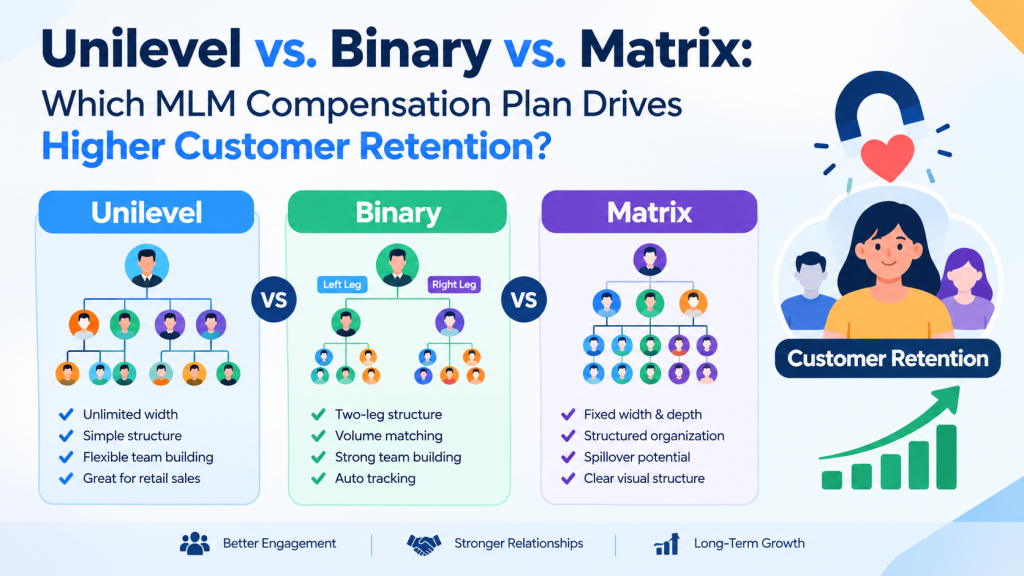

Unilevel vs. Binary vs. Matrix: Which MLM Compensation Plan Drives Higher Customer Retention?
Compare Unilevel, Binary, and Matrix MLM compensation plans and understand how compensation structure, customer experience, commissions, CRM, and retention strategies influence long-term MLM growth.
Introduction
Choosing the right MLM compensation plan is one of the most important decisions when launching a direct selling or network marketing business.
Three of the most widely used structures are Unilevel, Binary, and Matrix. Each model organizes distributors differently and can use different commission and team-building mechanics.
But another question is equally important: Which compensation plan can support better customer retention?
Therefore, instead of asking which plan is universally "best," businesses should evaluate which compensation structure fits their products, customers, sales process, economics, and retention strategy.
What Is an MLM Compensation Plan?
An MLM compensation plan defines how distributors, affiliates, or members can earn commissions and bonuses from qualifying sales or activities.
Depending on the model, commissions may be influenced by:
- Personal sales
- Customer purchases
- Team sales
- Downline volume
- Rank advancement
- Matching volume
- Leadership bonuses
- Referral activity
The structure determines how a distributor's organization is arranged and how commission calculations are performed. The FTC describes an MLM as a business model in which products or services are typically distributed through a network of participants, creating multiple levels of participants or "downlines." A well-designed compensation system should therefore align company revenue, customer value, distributor activity, and rewards rather than relying primarily on recruitment incentives.
Unilevel vs Binary vs Matrix at a Glance
| Feature | Unilevel | Binary | Matrix |
|---|---|---|---|
| Basic Structure | Unlimited width | Two legs | Fixed width and depth |
| Team Structure | Simple levels | Left and right legs | Grid-based |
| Recruitment Flexibility | High | Moderate | Controlled |
| Commission Calculation | Level-based | Volume/matching-based | Position/level-based |
| Team Visualization | Easy | Moderate | Structured |
| Spillover | Usually limited/not central | Possible depending on design | Common feature |
| Complexity | Low to moderate | Moderate to high | Moderate |
| Suitable For | Retail and relationship-based models | Team-building models | Structured network models |
| Customer Retention Potential | Depends on implementation | Depends on implementation | Depends on implementation |
1. What Is a Unilevel MLM Compensation Plan?
A Unilevel MLM compensation plan places distributors into levels beneath their sponsor. The first level can generally contain multiple personally sponsored members.
Commissions may be paid across a defined number of levels. The actual percentages, qualifications, and bonuses depend on the company's compensation rules.
Advantages of Unilevel
- Simple structure: New distributors can generally understand the genealogy quickly.
- Flexible team building: There is generally no two-leg limitation at the first level.
- Retail potential: The plan can be designed around genuine product sales.
- Easy reporting: Genealogy and level-based commissions can be presented clearly.
2. What Is a Binary MLM Compensation Plan?
A Binary MLM compensation plan generally organizes a distributor's organization into two primary legs.
Binary compensation systems commonly use concepts such as matching volume, carry-forward volume, pairing bonuses, cycle commissions, and rank qualification.
Advantages of Binary
- Easy-to-understand two-leg structure.
- Strong team-building orientation.
- Volume can be tracked automatically.
- Useful for businesses that require left/right volume management.
3. What Is a Matrix MLM Compensation Plan?
A Matrix MLM plan limits the number of positions at each level and normally defines a fixed width and depth.
Common Matrix structures include 2 × 2, 3 × 3, 4 × 4, and other customized configurations.
Advantages of Matrix
- Structured organization.
- Controlled width and depth.
- Potential for spillover functionality.
- Clear visual network structure.
- Can support rank and achievement systems.
Customer Retention in MLM: What Actually Matters?
Customer retention means encouraging customers to continue purchasing products or services over time.
Product Value
Customers are more likely to continue when products provide meaningful and consistent value.
Customer Experience
Support, delivery, communication, refunds, and overall service influence the customer relationship.
Engagement
CRM automation, loyalty programs, reminders, and personalized communication can support repeat purchases.
Can Unilevel Improve Customer Retention?
A Unilevel plan can support customer retention when its incentives are connected to genuine product sales and repeat customer activity.
For example, a company could design incentives around:
- Personal customer purchases
- Repeat orders
- Customer subscriptions
- Team retail volume
- Customer loyalty milestones
The compensation plan can then work together with a CRM system that tracks customer activity, purchase history, and renewal behavior.
Can Binary Improve Customer Retention?
A Binary plan can support customer retention when its incentives are connected to genuine product or service consumption and sustainable sales volume.
Businesses should carefully evaluate whether their Binary rules reward sustainable customer sales or unintentionally place excessive emphasis on recruitment or qualification purchases.
Can Matrix Improve Customer Retention?
Matrix structures can support retention when they are combined with strong customer management and clearly defined sales incentives.
A Matrix business can combine its organizational structure with:
- Customer purchase tracking
- Repeat-order incentives
- Loyalty rewards
- Retail sales commissions
- Customer referral programs
- Rank advancement
Which Plan Is Better for Customer Retention?
Instead, businesses should select a structure based on their products, customers, sales process, operational model, and legal requirements.
| Business Objective | Structure to Consider |
|---|---|
| Simple network structure | Unilevel |
| Flexible first-level team building | Unilevel |
| Two-leg organization | Binary |
| Volume matching | Binary |
| Fixed-width organization | Matrix |
| Structured depth | Matrix |
| Highly customized business | Hybrid / Custom |
7 Ways to Design an MLM Compensation Plan for Better Retention
1. Reward Genuine Customer Sales
Commission rules should encourage distributors to sell products or services to customers who genuinely want them.
2. Create Customer Loyalty Rewards
- Loyalty points
- Repeat purchase bonuses
- Subscription rewards
- Customer milestones
- Referral rewards
- VIP customer tiers
3. Track Customer Churn
4. Use CRM Automation
An integrated MLM CRM can track registration, purchase history, last order, repeat purchases, communication history, support tickets, distributor ownership, and customer status.
5. Avoid Artificial Purchase Pressure
A sustainable MLM strategy should distinguish between genuine product demand and purchases made primarily to maintain compensation eligibility.
6. Make Commission Calculations Transparent
Customer Sales: $4,800
Team Sales: $12,500
Qualified Volume: $10,000
Commission Earned: $750
7. Measure Retention Instead of Assuming It
Important metrics include:
- Customer retention rate
- Customer churn rate
- Repeat purchase rate
- Customer lifetime value
- Average order value
How MLM Software Supports Different Compensation Plans
Modern MLM software can automate many of the calculations and operational processes required by different compensation structures.
Unilevel
Level commissions, generation bonuses, personal sales, team volume, and rank bonuses.
Binary
Left/right volume, matching bonuses, carry-forward volume, pairing commissions, and cycle calculations.
Matrix
Matrix placement, spillover, level commissions, position management, and rank progression.
Why a Hybrid Compensation Plan Can Be Useful
Some businesses do not want to rely on a single compensation structure. They may combine different mechanisms to create a customized model.
The advantage of customization is flexibility. The challenge is complexity. Therefore, every compensation plan should remain understandable to distributors and customers.
How Hybrid MLM Software Can Help
Hybrid MLM Software provides a platform for businesses that need to manage multiple compensation structures and broader network marketing operations.
- Compensation plan management
- Genealogy management
- Binary tree
- Unilevel structure
- Matrix structure
- Commission engine
- E-wallet
- Payout management
- CRM
- Sales tracking
- Reports and analytics
- Admin and distributor dashboards
What Should an MLM Company Measure?
Customer Metrics
- New customers
- Active customers
- Repeat customers
- Customer churn
- Repeat purchase rate
- Average order value
- Customer lifetime value
Distributor Metrics
- Active distributors
- New distributors
- Distributor retention
- Personal sales
- Team sales
- Rank advancement
- Commission activity
Compensation Metrics
- Total commissions
- Commission per customer
- Retail sales volume
- Team sales volume
- Bonus distribution
- Qualification rates
Engagement Metrics
- Login frequency
- Mobile app activity
- Customer follow-ups
- Campaign engagement
- Referral activity
These measurements provide a much clearer picture of whether the business model is actually retaining customers.
Compliance Should Be Part of Compensation-Plan Design
Compensation plans should not be designed solely around growth or recruitment. Companies should also evaluate local direct-selling regulations, consumer protection requirements, advertising rules, earnings claims, product claims, refund policies, disclosure requirements, privacy, tax, and payment regulations.
The compensation structure should be reviewed by appropriate legal and compliance professionals before launch, particularly when the business operates across multiple countries.
Final Takeaway: Unilevel, Binary, or Matrix?
Instead of asking: "Which MLM compensation plan has the highest customer retention?"
A better question is:
Unilevel can be suitable when simplicity, flexible team building, and retail sales are important.
Binary can be suitable when a business wants a two-leg structure and volume-based team incentives.
Matrix can be suitable when a company wants a defined-width and defined-depth organizational structure.
Hybrid can be useful when a business requires multiple compensation mechanisms and a customized model.
Conclusion
Unilevel, Binary, and Matrix compensation plans each provide different ways to organize distributors and calculate rewards.
However, customer retention should not be treated as a direct consequence of the compensation-plan label. A company can build a retention-focused MLM business with any of these structures when its overall system encourages genuine customer demand, provides strong customer experiences, communicates commissions clearly, and uses data to identify and reduce churn.
For companies planning to launch or upgrade an MLM business, the compensation plan should be designed together with the CRM, e-commerce system, commission engine, customer loyalty strategy, analytics, and compliance framework.
Build Your MLM Business With Powerful MLM Software
Manage Unilevel, Binary, Matrix, and customized compensation structures with a centralized MLM software platform.
Explore Hybrid MLM Software