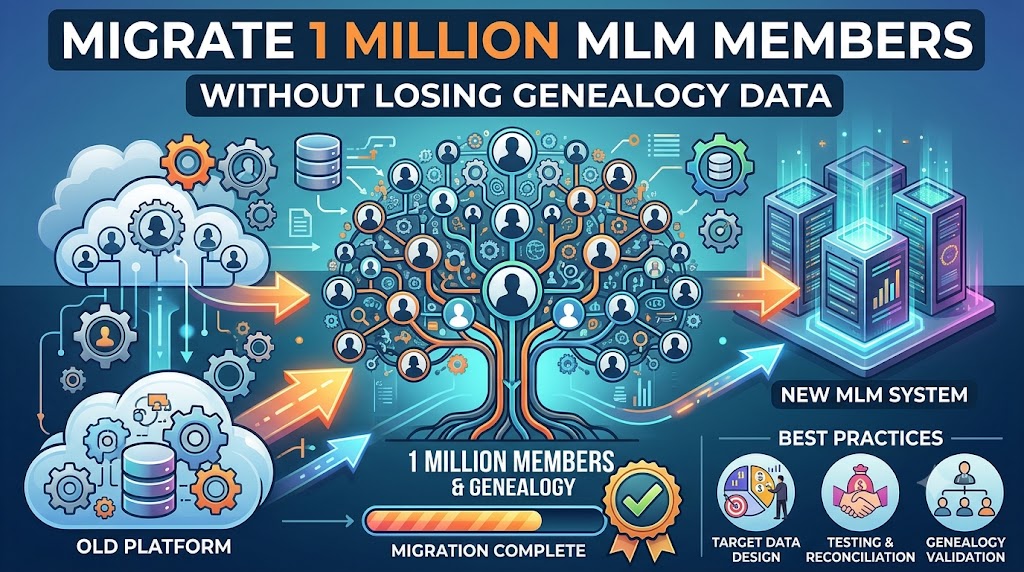

Migrating an MLM business with thousands—or even 1 million+ members—to a new software platform is not a simple database export and import. Your distributor genealogy, sponsor relationships, commissions, e-wallet balances, orders, ranks, purchases, customer records, and historical transactions are all connected.
A poorly planned migration can result in missing members, broken genealogy relationships, incorrect commission balances, duplicate records, lost transaction history, or downtime that affects distributors and customers.
That is why large-scale MLM software migration requires careful planning, data mapping, validation, testing, and controlled deployment.
Hybrid MLM Software supports large MLM deployments with 1 million+ users and can help businesses migrate from an existing MLM system to a new platform through a structured migration process. The Hybrid MLM team works with existing databases and business requirements to map, transform, migrate, and validate the required data while maintaining important relationships and historical information.
Whether you are moving from an outdated MLM platform, a custom-built system, another MLM software provider, or a legacy database, the goal is the same:
network data and day-to-day operations.
What Is MLM Software Migration?
MLM software migration is the process of moving your existing network marketing business data, configuration, and historical records from one MLM platform or database to another.
A complete migration can include:
- Member accounts
- Sponsor relationships
- Placement relationships
- Genealogy trees
- Referral information
- Customer records
- Product data
- Orders
- Invoices
- Payments
- Commission history
- E-wallet balances
- Payout records
- Rank information
- Bonus records
- Subscription information
- KYC information
- Addresses
- Contact details
- Login information
- User activity
- Transaction history
- Reports
- Other business-specific data
The exact migration scope depends on the existing system, database structure, data quality, and the requirements of the new MLM platform.
Why Migrating 1 Million MLM Members Is Different
A migration involving 1 million members is fundamentally different from moving a small MLM database.
With a large network, even a small data-mapping error can affect thousands of downstream records.
For example:
Member
   ↓
Sponsor
   ↓
Placement
   ↓
Genealogy
   ↓
Orders
   ↓
Commission
   ↓
E-Wallet
   ↓
Payout
These relationships need to remain logically consistent after migration.
If Member A’s sponsor ID changes during migration but Member B still references the old sponsor ID, the genealogy can become disconnected.
This is why large-scale migration should be treated as a data engineering and business continuity project, not simply a database import.
Can MLM Software Support 1 Million+ Members?
Yes. Hybrid MLM Software is designed to support large MLM deployments, including businesses with 1 million+ users and growing networks.
For large organizations, scalability depends on more than the number of registered members. Performance can also be affected by:
- Number of daily active users
- Transaction volume
- Orders
- Commission calculations
- Genealogy queries
- Database size
- API requests
- Reporting requirements
- Concurrent users
- Payment transactions
- Background jobs
- Mobile application traffic
- Third-party integrations
Hybrid MLM’s modular architecture allows the platform to be configured according to the scale and requirements of the business.
For very large deployments, infrastructure, database architecture, caching, queues, server resources, and optimization should be planned according to the expected workload.
Can Hybrid MLM Migrate an Existing MLM System?
Yes.
Hybrid MLM Software provides migration support for businesses moving from an existing MLM system to a new Hybrid MLM platform.
The migration team can work with your existing database and software structure to understand:
- What data exists
- Where the data is stored
- How tables are related
- How members are connected
- How commissions are calculated
- How wallet transactions are recorded
- How orders are stored
- How ranks are maintained
- Which historical records need to be preserved
- Which data needs transformation before import
The objective is to create a controlled migration process rather than simply copying tables from one database to another.
Full MLM Data Migration
A professional MLM migration should go beyond member accounts.
Depending on your existing system, Hybrid MLM can plan migration for different categories of business data.
Table of Contents
Toggle1. Member Data
Member information can include:
- Member ID
- Username
- Name
- Mobile number
- Date of registration
- Sponsor
- Placement
- Rank
- Status
- Address
- Country
- Language
- Currency
- Profile information
2. Genealogy Data
Genealogy is one of the most critical parts of MLM migration.
Your existing structure may include:
- Sponsor tree
- Placement tree
- Binary left/right positions
- Unilevel levels
- Matrix positions
- Parent-child relationships
- Referral relationships
- Team relationships
- Rank relationships
The migration process should map these relationships into the new system before importing the network.
Example
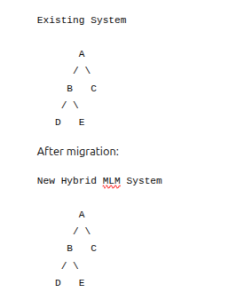
The member IDs may change internally, but the logical relationships should remain correctly mapped.
3. Sponsor & Referral Data
Sponsor relationships are essential for commission calculations and genealogy.
During migration, the system should map:
Old Sponsor ID
        ↓
Member Mapping
        ↓
New Member ID
        ↓
New Sponsor Relationship
This prevents old database IDs from being incorrectly inserted into the new database.
4. Commission History
Historical commission data may include:
- Direct commissions
- Binary commissions
- Matching bonuses
- Level commissions
- Rank bonuses
- Generation bonuses
- Referral bonuses
- Performance bonuses
- Other custom commissions
The migration team should determine whether historical commission records need to be imported exactly as they appear in the old system or transformed into the new platform’s transaction structure.
5. E-Wallet & Balance Migration
Wallet migration requires special attention.
A member may have:
Opening Balance
+ Commission
+ Bonus
+ Adjustments
- Purchases
- Withdrawals
- Transfers
= Closing Balance
The migration process should reconcile these values rather than simply copying a single balance field.
For example:
Old system wallet balance: $1,250
The migration team should verify whether the balance agrees with the underlying wallet transactions.
6. Order & Purchase History
For product-based MLM businesses, order history can be extremely important.
Migration may include:
- Order ID
- Customer
- Distributor
- Products
- Quantity
- Price
- Discounts
- Tax information
- Payment status
- Order status
- Shipping information
- Refunds
- Order dates
Historical orders may also affect commissions, ranks, volume, and qualification rules.
7. Rank & Qualification Data
If your business uses rank-based rewards, the migration may need to preserve:
- Current rank
- Previous rank
- Rank achievement date
- Qualification history
- Team volume
- Personal volume
- Group volume
- Rank bonuses
This information can be important for maintaining continuity after migration.
8. KYC & Compliance Records
Where applicable and legally appropriate, migration may include:
- KYC status
- Verification status
- Identity information
- Approved documents
- Tax-related records
- Bank information
- Payout information
Sensitive information should be handled using appropriate security controls and access restrictions throughout the migration.
9. Customer & CRM Data
A complete migration can also cover CRM information such as:
- Leads
- Customers
- Follow-ups
- Notes
- Contact information
- Referral sources
- Customer status
- Communication history
This helps prevent the business from losing valuable customer information during the platform transition.
The Hybrid MLM Migration Process
A large-scale migration should follow a controlled process.
Step 1: Discovery & Migration Assessment
The Hybrid MLM team first reviews your existing system.
This may include:
- Existing software
- Database type
- Database size
- Number of members
- Number of active users
- Compensation plan
- Tables
- Relationships
- APIs
- Integrations
- Transaction volume
- Historical data
- Custom modules
The purpose is to understand the complete migration environment before moving any production data.
Step 2: Database Analysis
The source database is analyzed to identify:
- Tables
- Primary keys
- Foreign keys
- Relationships
- Duplicate records
- Missing values
- Invalid references
- Archived records
- Transaction structures
- Custom fields
This creates a map of the existing system.
Step 3: Data Mapping
The old database and new Hybrid MLM database are mapped field by field.
Example:
| Existing System | Hybrid MLM System |
|---|---|
| old_member_id | member_id |
| sponsor_id | sponsor_id |
| parent_id | placement_parent_id |
| left_position | left_position |
| right_position | right_position |
| wallet_amount | wallet_balance |
| rank_id | rank_id |
| order_number | order_id |
The actual mapping depends on the source system and the target configuration.
Step 4: Data Cleaning
Before migration, the source data should be checked for:
- Duplicate members
- Invalid emails
- Duplicate mobile numbers
- Missing sponsor IDs
- Broken genealogy
- Invalid transactions
- Negative or inconsistent balances
- Duplicate orders
- Missing product references
- Incorrect dates
- Invalid status values
Cleaning the source data before importing it can prevent problems later.
Step 5: Migration Development
A migration process is then created according to the source database.
This may involve:
- SQL migration scripts
- Data transformation
- API migration
- Custom import tools
- ID mapping
- Relationship mapping
- Data validation
- Transaction conversion
For a large network, automated migration scripts are generally more practical than manually importing records.
Step 6: Test Migration
Before touching the production environment, the data is migrated into a testing environment.
The team can then compare:
Source System
      ↓
Migration
      ↓
Hybrid MLM Test Environment
      ↓
Validation
This allows issues to be identified before the final migration.
Step 7: Genealogy Validation
This is one of the most important migration checks.
The team should verify:
- Total members
- Sponsor relationships
- Placement relationships
- Left/right positions
- Parent-child relationships
- Network depth
- Network width
- Referral relationships
- Rank structure
Sample members from different levels of the network should also be checked manually.
Step 8: Financial Reconciliation
Financial data should be reconciled before launch.
For example:
Commission
Old System Commission
          =
Migrated Commission
Wallet
Old Wallet Balance
          =
Migrated Wallet Balance
Orders
Old Order Count
          =
Migrated Order Count
Any discrepancy should be investigated before production launch.
Step 9: Performance Testing
For a 1 million+ member network, testing should include realistic workloads.
Test areas can include:
- Login
- Dashboard
- Genealogy
- Member search
- Commission calculations
- Wallet
- Orders
- Reports
- Admin operations
- APIs
- Mobile requests
- Concurrent users
The goal is to identify bottlenecks before the new platform goes live.
Step 10: Final Migration
Once testing and reconciliation are completed, the final migration can be scheduled.
A typical process may involve:
Production Backup
        ↓
Data Freeze / Cutoff
        ↓
Final Data Export
        ↓
Final Migration
        ↓
Data Validation
        ↓
Financial Reconciliation
        ↓
Genealogy Validation
        ↓
System Testing
        ↓
DNS / Application Switch
        ↓
Go Live
The exact approach depends on the existing system and business requirements.
Step 11: Post-Migration Monitoring
Migration does not end when the new system goes live.
The initial period should include monitoring of:
- Login activity
- Distributor registrations
- Genealogy
- Orders
- Commissions
- Wallets
- Payouts
- APIs
- Payment gateways
- Mobile applications
- Reports
- Server performance
This helps identify issues that may only appear under real-world usage.
How to Avoid Losing Genealogy Data
Genealogy should be treated as a relationship structure rather than a simple list of members.
Before migration, identify:
Sponsor relationship
Who introduced the member?
Placement relationship
Where is the member positioned in the compensation tree?
Position
For Binary systems:
Left
Right
Parent
Who is the member’s placement parent?
Children
Which members are directly positioned underneath?
Level
How deep is the member in the network?
These relationships should be mapped carefully during migration.
How to Handle Member IDs During Migration
One of the common mistakes is assuming that the old member ID can simply be copied into the new database.
A safer approach can be:
Old ID
  ↓
Migration Mapping Table
  ↓
New ID
  ↓
Relationship Conversion
For example:
| Old ID | New ID |
|---|---|
| 10001 | 500001 |
| 10002 | 500002 |
| 10003 | 500003 |
The migration process then uses the mapping table to rebuild sponsor, placement, transaction, order, and wallet relationships.
What Happens to Existing MLM Commissions?
This depends on your migration requirements.
There are generally two approaches.
Option 1 — Historical Migration
Import historical commissions exactly as recorded in the previous system.
This preserves the historical financial record.
Option 2 — Recalculation
Recalculate certain commissions using the new system’s compensation rules.
This requires significantly more validation because the new system must reproduce the historical business logic accurately.
The appropriate method should be decided before migration.
What About Existing Member Login Credentials?
Password migration depends on the security and password-hashing method used by the existing system.
If the existing password hashes are compatible with the new authentication system, they may potentially be migrated.
If they are not compatible, a secure password-reset process may be required.
Plain-text passwords should never be extracted or transferred.
How Long Does a 1 Million Member Migration Take?
There is no universal migration time.
The duration depends on:
- Database size
- Number of tables
- Data complexity
- Transaction volume
- Genealogy depth
- Number of integrations
- Data quality
- Custom modules
- Source database access
- Required validation
- Downtime requirements
A 1 million-member database with relatively simple data can have very different migration requirements from a 1 million-member system containing years of orders, commissions, wallet transactions, KYC records, and multiple integrations.
For that reason, the migration team should perform a technical migration assessment before providing a final timeline.
Can Migration Be Done Without Losing Business Data?
Hybrid MLM Software’s migration process is designed to preserve the required business data and relationships during the transition.
The Hybrid MLM team can work with your existing system to migrate the agreed data set into the new platform, including member information, genealogy relationships, commissions, wallets, orders, ranks, and other supported records.
However, a responsible migration project should never rely on a blanket “zero risk” promise.
Instead, data integrity should be demonstrated through:
- Source-to-target record counts
- Genealogy validation
- Financial reconciliation
- Transaction comparisons
- Sample testing
- Duplicate detection
- Backup procedures
- Migration logs
- Acceptance testing
This creates measurable evidence that the migrated system matches the agreed migration scope.
Why Businesses Migrate to a New MLM Platform
Companies often consider migration when their existing system has become difficult to maintain or no longer supports their growth.
Common reasons include:
Outdated Technology
Legacy software may not support modern APIs, mobile applications, or integrations.
Limited Compensation Plans
Businesses may need a more flexible compensation engine.
Performance Problems
Growing networks can expose limitations in older systems.
Poor Reporting
Management may require more detailed business analytics.
Limited Integrations
Businesses may need Shopify, WooCommerce, CRM, payment, ERP, or custom API integrations.
High Recurring Costs
Some companies may prefer a different pricing or ownership model.
Lack of Customization
A business may need its software to match a unique compensation structure.
Poor Support
Migration may become necessary when an existing vendor cannot provide the required technical support.
Why Choose Hybrid MLM Software for Large-Scale Migration?
Hybrid MLM Software combines MLM functionality with a configurable technology platform designed for growing network marketing businesses.

Key capabilities include:
- 1 million+ user support
- 350+ modules
- 16+ compensation plans
- Binary
- Unilevel
- Matrix
- Hybrid
- Board
- Generation
- Affiliate
- Custom compensation models
- Genealogy
- Commission engine
- E-wallet
- Payout management
- CRM
- Reports
- Mobile applications
- APIs
- E-commerce integrations
- Payment gateway integrations
- Custom development
- MLM migration support
The migration team can work with your existing system to plan and execute a structured transition based on your database, business rules, and required data.
A 1 Million+ Member Migration Checklist
Before starting your migration, make sure you have documented:
Business
Compensation plan
Commission rules
Rank rules
Bonus rules
Qualification rules
Product structure
Refund rules
Member Data
Member profiles
Sponsor relationships
Placement relationships
Genealogy
Rank
Status
KYC
Financial Data
Commission history
Wallet balances
Wallet transactions
Payout history
Adjustments
Refunds
E-Commerce
Products
Orders
Customers
Payments
Refunds
Shipping information
Technical
Database backup
Database schema
API documentation
Third-party integrations
Domain/DNS
Hosting
SSL
Email/SMS configuration
The migration team can work with your existing system to plan and execute a structured transition based on your database, business rules, and required data.
Final Thoughts
Migrating 1 million MLM members is a major technology project, but it does not have to mean starting your network from zero.
With proper planning, database mapping, genealogy validation, financial reconciliation, testing, and controlled deployment, an established MLM business can move to a modern platform while preserving the data and relationships that matter.
Hybrid MLM Software supports large-scale MLM deployments with 1 million+ users and provides migration support for businesses moving from existing MLM systems.
Our team can analyze your existing platform, understand your compensation structure and database, map the required data, perform test migrations, validate the results, and plan the final transition.
Ready to Move Your MLM Business to a New Platform?
Don’t risk your network data with an unplanned migration.
Talk to the Hybrid MLM team about your existing system and migration requirements.