
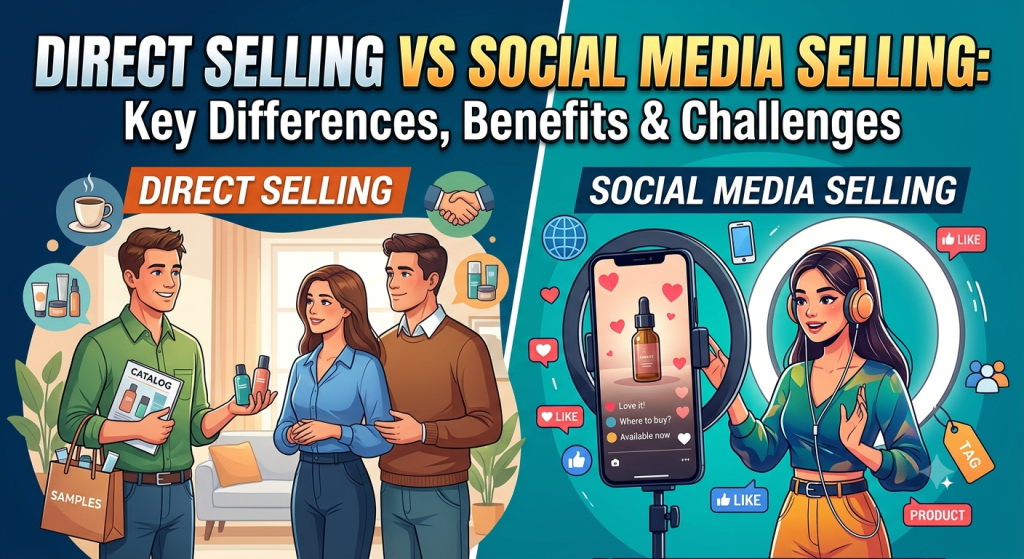

Customer buying habits continue to evolve. Many people value personal recommendations and product demonstrations, while others discover products through social platforms, videos, creator content, and online communities. For businesses, understanding how these approaches differ can help shape a practical sales strategy.
1. Introduction: How Are Selling Methods Changing?
Direct selling has traditionally relied on personal recommendations, product demonstrations, consultations, and relationships between sellers and customers. Social media has added digital ways to discover products, share experiences, build communities, and communicate with potential buyers.
These approaches are not necessarily competitors. A direct selling business can use social media to share product education, arrange demonstrations, answer questions, and maintain contact with customers. A business that primarily sells through social platforms may also use personal consultations or in-person events to build trust.
The best approach depends on the product, target audience, buying journey, sales resources, and applicable rules. Businesses should focus on customer value and transparent selling practices rather than assuming one channel is always superior.
2. What Is Direct Selling?
Direct selling is a distribution approach in which a seller offers products or services directly to customers, commonly outside a conventional fixed retail location. Sales may happen through one-to-one consultations, home demonstrations, community events, referrals, or digital conversations.
Some direct selling companies use independent distributors. Others operate with sales representatives or different direct-to-customer arrangements. Multi-level marketing (MLM) is one possible compensation and distribution model within the wider direct selling landscape, but not every direct selling business is an MLM business.
How does direct selling work?
- Product knowledge: The seller learns about the product, its appropriate uses, price, and terms.
- Customer outreach: The seller connects with prospective customers through personal networks, referrals, events, or other permitted channels.
- Product explanation: The seller answers questions and may demonstrate the product.
- Order and fulfilment: The customer places an order and receives the product or service under the seller's process.
- Follow-up: The seller provides appropriate after-sales support and seeks feedback.
Examples of direct selling
- A representative demonstrating household products to customers.
- A beauty consultant recommending products based on a customer's preferences.
- A distributor taking orders during a community event.
- A direct sales representative arranging a product consultation by appointment.
3. What Is Social Media Selling?
Social media selling uses social platforms to introduce products, educate audiences, answer questions, develop customer relationships, and encourage purchases. Depending on the platform and business setup, customers may complete purchases within a social commerce experience or move to a website, messaging conversation, or other checkout process.
Social selling and social commerce are related but distinct terms. Social selling often describes using social channels to build relationships and support the sales process. Social commerce focuses more specifically on discovering and purchasing products through social platforms or connected shopping experiences.
How does social media selling work?
- Publish useful content: Share product information, demonstrations, tutorials, and answers to common questions.
- Engage with the audience: Respond to comments and messages in a timely, professional way.
- Build confidence: Provide accurate product details, transparent pricing, and authentic customer feedback where permission has been given.
- Guide interested customers: Direct them to an appropriate product page, consultation, or checkout.
- Measure results: Review enquiries, qualified leads, conversions, and customer retention where tracking is available.
Common social media selling channels
- Instagram: Visual product content, Reels, Stories, and direct conversations.
- Facebook: Pages, groups, community engagement, and eligible commerce features.
- YouTube: Demonstrations, tutorials, product explainers, and longer educational videos.
- TikTok: Short-form video discovery and creator-led product education, subject to local availability and platform rules.
- Messaging platforms: Customer questions, follow-ups, and order assistance where permitted and appropriate.
- LinkedIn: Relationship building and business-to-business selling where relevant.
Platform features and shopping availability differ by country, account type, and policy. Check each platform's current rules before launching a campaign.
4. Direct Selling vs Social Media Selling: Key Differences
The main distinction is the sales method. Direct selling emphasizes direct seller-to-customer interaction; social media selling uses digital social channels to reach and engage potential customers. A business may use both in one customer journey.
| Factor | Direct Selling | Social Media Selling |
|---|---|---|
| Primary channel | Personal meetings, demonstrations, referrals, events, or direct consultations | Social posts, videos, live streams, messages, communities, and social shopping tools |
| Customer interaction | Often personal and conversation-led | Often digital, public, private, or community-based |
| Audience reach | May start with local communities and personal networks | Can reach wider or geographically dispersed audiences, depending on content and distribution |
| Product demonstration | May allow hands-on or in-person demonstrations | Uses video, images, live sessions, and digital explanations |
| Relationship building | Often based on direct conversations and follow-up | Can use ongoing content, comments, messages, and online communities |
| Costs | May include travel, event, sample, and meeting costs | May include content production, tools, creator fees, and advertising |
| Measurement | May require CRM or sales records to track activity | May offer platform analytics, website tracking, and campaign metrics |
| Customer journey | Can move from consultation to order and follow-up | Can move from content discovery to message, website, or in-platform checkout |
| Key risks | Inconsistent follow-up, travel costs, and limited time for individual conversations | Platform dependence, changing reach, public feedback, privacy, and content competition |
Neither method guarantees better results. Performance depends on the offer, customer expectations, seller skills, content quality, fulfilment, and the ability to follow up consistently.
5. Benefits of Direct Selling
Personalized customer conversations
Sellers can ask questions, understand customer needs, and tailor explanations to the situation. This can be valuable for products that require guidance or a demonstration.
Product demonstrations
Some products are easier to explain when customers can see or experience them directly. Demonstrations may help answer practical questions before a purchase.
Direct feedback
One-to-one conversations can reveal objections, product questions, and customer expectations. Businesses can use this feedback to improve product information and service.
Relationship-led follow-up
With customer permission, sellers can follow up after a purchase, provide support, and share relevant updates. Follow-up should be useful and respectful, not excessive or intrusive.
Potential challenges of direct selling
- In-person meetings and travel can require time and money.
- Individual conversations may limit how many customers one seller can serve.
- Results may depend heavily on the seller's communication and product knowledge.
- Sales records can become fragmented without a consistent process or suitable tools.
6. Benefits of Social Media Selling
Broader discovery opportunities
Social content can introduce products to people outside a seller's immediate network. Actual reach depends on audience fit, content, platform distribution, and any paid promotion.
Reusable product education
A clear tutorial or product demonstration can answer common questions for many viewers. Sellers can reuse and update useful content instead of explaining the same basics individually each time.
Ongoing customer engagement
Comments, messages, livestreams, and communities create opportunities to answer questions and understand customer interests. Businesses should respond accurately and avoid making unsupported claims.
Measurable campaign activity
Depending on the tools used, businesses can measure views, clicks, enquiries, conversions, and other indicators. Metrics should be interpreted carefully: reach and engagement alone do not prove profitable sales.
Potential challenges of social media selling
- Platform algorithms and policies can change.
- Content competes with many other posts and advertisements.
- Negative comments or inaccurate information may spread quickly.
- Businesses must respect privacy, advertising disclosures, and platform rules.
- Turning attention into completed, profitable sales requires a clear customer journey.
7. Challenges to Consider Before Choosing a Channel
Before investing in a sales channel, assess the practical work needed to operate it well.
| Challenge | Direct Selling Response | Social Media Selling Response |
|---|---|---|
| Building trust | Use clear product explanations, transparent pricing, and reliable follow-up. | Publish accurate content, disclose commercial relationships, and respond openly to questions. |
| Tracking enquiries | Record customer interactions and next steps in a consistent system. | Organize messages and leads, and use consent-based tracking where appropriate. |
| Maintaining consistency | Provide seller training and approved product information. | Use a content plan and keep posts aligned with current product details. |
| Measuring results | Track conversations, orders, repeat purchases, and costs. | Track qualified leads, conversion rates, order value, and acquisition costs. |
| Compliance | Train sellers on product claims, consumer rights, and compensation policies. | Follow advertising, privacy, disclosure, and platform requirements. |
Important for MLM and direct selling businesses
Marketing claims should be accurate and substantiated. Do not promise guaranteed income, imply that recruitment alone creates legitimate earnings, or exaggerate product results. Review the laws and regulations that apply in every market where you operate.
8. How to Combine Direct Selling and Social Media Selling
For many businesses, the most practical strategy is not choosing one channel exclusively. Social media can help people discover a product, while direct conversations can answer detailed questions and support the purchase decision.
A simple omnichannel workflow
- Attract: Publish useful posts, product demonstrations, tutorials, or educational videos.
- Engage: Answer questions and invite interested people to request more information.
- Understand: Ask appropriate questions to learn what the customer needs, without collecting unnecessary personal information.
- Advise: Offer a consultation or demonstration when it adds value.
- Convert: Provide a clear and secure ordering process with transparent prices and terms.
- Support: Follow up appropriately, answer product questions, and handle service issues.
- Improve: Review customer feedback and channel performance to refine the process.
Example
A home-care product distributor publishes a short video demonstrating how a product is used. An interested viewer asks a question in a message. The distributor explains the product accurately, offers a demonstration if useful, and shares a clear ordering option. After the purchase, the distributor provides appropriate support.
This approach combines digital discovery with personal service without treating social media reach as a substitute for customer trust or product quality.
9. The Role of Direct Selling and MLM Software
When a business manages multiple sellers, customer orders, and follow-up activities, software can help centralize operational information. The right system depends on whether the business needs general direct sales management, multi-level compensation, e-commerce support, or a combination.
Features businesses may need
- Distributor management: Maintain seller profiles, account status, and relevant activity records.
- Genealogy management: For MLM models, record sponsor relationships and display the configured network structure.
- Commission automation: Calculate commissions from eligible transactions using documented compensation rules.
- Order and sales tracking: Keep order information organized and connect sales data where supported.
- Reporting: Review sales, activity, commissions, and payout records.
- E-commerce integrations: Synchronize compatible store data when the integration supports the required workflows.
- Role-based access: Ensure users can access only the information and actions appropriate to their role.
MLM software is not a replacement for social media content, customer service, or sales strategy. It supports the operational processes behind the business. Before purchasing a platform, confirm the available features, integrations, security controls, support terms, and total cost.
10. How to Choose the Right Selling Strategy
Use these questions to determine which channel—or combination of channels—fits your business.
- Where do customers prefer to learn? Some audiences value demonstrations and consultations; others prefer videos, reviews, and online research.
- Does the product need explanation? Products that require tailored guidance may benefit from direct conversations alongside digital content.
- What resources are available? Consider staff time, content production, travel, software, and advertising budgets.
- Can you fulfil demand? Ensure stock, delivery, payment, returns, and support processes can handle the sales you generate.
- How will success be measured? Define meaningful metrics such as qualified enquiries, conversion rate, customer retention, and net profitability.
- What rules apply? Check consumer protection, advertising, privacy, direct selling, and platform requirements for your market.
Test a manageable campaign, review the results, and improve it based on customer feedback and reliable data. Avoid assuming that a high number of views or contacts automatically means strong business performance.
11. Frequently Asked Questions
What is the difference between direct selling and social media selling?
Direct selling involves selling directly to customers, often through personal interactions or demonstrations. Social media selling uses social platforms to promote products, engage prospects, and support purchases. Businesses can combine both methods.
Is direct selling better than social media selling?
Neither is always better. Direct selling can suit products that benefit from personal consultation, while social media can support discovery and ongoing digital engagement. The right choice depends on customers, products, resources, and goals.
What is social selling compared with social commerce?
Social selling focuses on using social channels to build relationships and support sales. Social commerce focuses on shopping and purchasing through social platforms or connected social shopping experiences.
Can direct selling businesses use social media?
Yes. Direct sellers can use social media to share accurate product information, answer questions, host demonstrations, generate enquiries, and direct customers to suitable ordering channels, subject to relevant rules.
How can social media help network marketing businesses?
Social media can support product education, community engagement, customer enquiries, and brand discovery. Businesses should follow platform policies and avoid misleading product or income claims.
What software helps manage a direct selling business?
The right software depends on the operating model. Businesses may need customer and order management, reporting, and follow-up tools. MLM businesses may also require genealogy management, compensation calculations, and distributor account features.
Does MLM software manage social media marketing?
Not necessarily. MLM software generally focuses on distributor networks, compensation, orders, and related operations. Social media publishing, advertising, and engagement may require separate tools or integrations.
How can I measure social media selling performance?
Track relevant measures such as qualified enquiries, click-throughs, conversion rate, customer acquisition cost, order value, repeat purchases, and profitability. Choose metrics that reflect business outcomes rather than reach alone.
12. Conclusion
Direct selling and social media selling offer different ways to connect with customers. Direct selling emphasizes personal interaction and consultation, while social media selling helps businesses use digital content and social platforms to reach and engage audiences.
For many businesses, combining both approaches creates a flexible customer journey: social content supports discovery, personal conversations address individual needs, and a clear ordering and support process completes the experience.
The most effective strategy is the one that matches your customers, product, resources, and compliance responsibilities. Use accurate product information, measure meaningful outcomes, and choose software that supports the business processes you actually need.
Explore software for network marketing operations
If your business needs to manage distributor networks, compensation rules, sales activity, and reporting, explore the available features and terms from HybridMLM.
Visit HybridMLM.ioEditorial note: This article provides general business information, not legal, financial, or platform-specific advice. Verify current platform features and local regulatory requirements before acting.