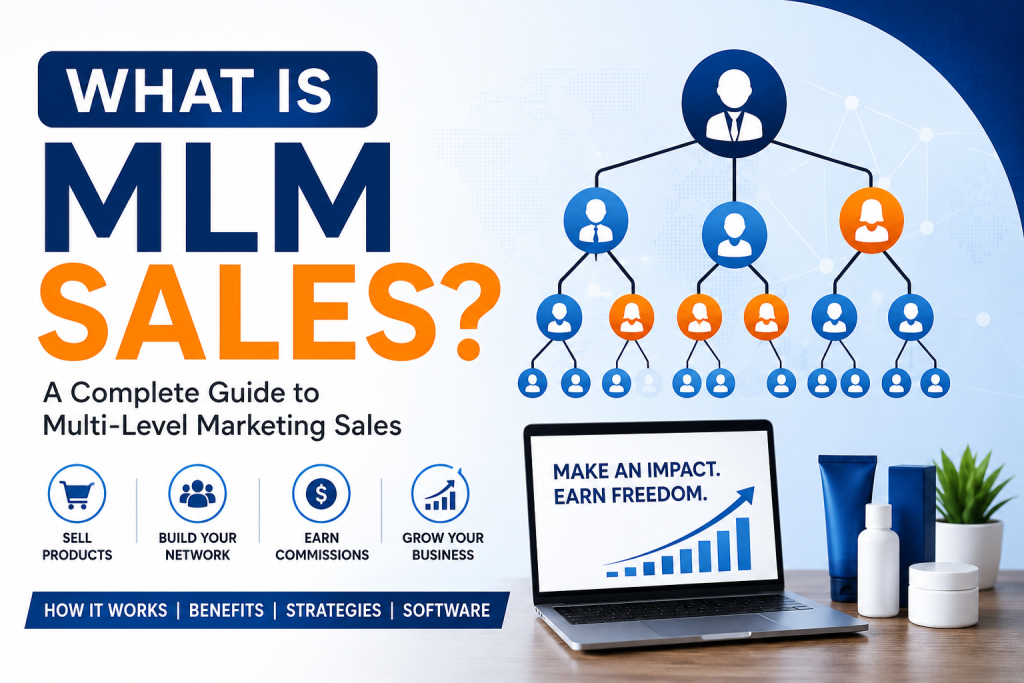

MLM sales, short for multi-level marketing sales, is a business model where products or services are sold directly to customers through a network of independent distributors or representatives. In an MLM structure, distributors may generate income from their own product sales and, depending on the company’s compensation structure, from qualifying sales generated by members they introduce into the organization.
MLM is also commonly referred to as network marketing or direct selling. The model relies heavily on person-to-person selling, relationship building, referrals, customer acquisition, and distributor networks. The U.S. Federal Trade Commission describes MLM businesses as companies that sell products or services through person-to-person sales and may involve recruiting other people to sell as well.
For a growing MLM company, managing sales manually can become difficult. As the distributor network grows, businesses need to track customers, orders, sales volume, referrals, team performance, commissions, payouts, and other operations. This is where MLM software or network marketing software can become an important business-management tool.
Table of Contents
ToggleWhat is MLM Software
What Is MLM Sales?
MLM sales is a sales approach in which products or services are marketed and sold through a network of independent distributors rather than relying only on traditional retail stores or an internal employee sales team.
The basic concept is simple:
A company provides a product or service → a distributor sells it to customers → the distributor may introduce new distributors → those distributors generate their own sales → commissions and incentives are calculated according to the company’s compensation plan.
The exact structure varies from one MLM company to another. Some businesses emphasize retail sales, while others combine personal sales with team-based incentives.
Unlike a traditional sales organization where sales representatives normally report to a direct manager, an MLM business can have multiple levels within its distributor network. This network is commonly represented using a genealogy tree, showing sponsors, downline members, ranks, sales volume, and other relationships.
How Does MLM Sales Work?
The MLM sales process generally combines direct selling with network development.
1. The Company Offers Products or Services
Every legitimate MLM business begins with products or services that customers can purchase. These may include:
- Health and wellness products
- Beauty and personal care products
- Household products
- Financial or business services
- Digital products
- Educational products
- Lifestyle products
- Subscription-based services
The product or service should provide genuine value to customers and form the foundation of the company’s sales strategy.
2. Distributors Join the Business
Individuals can join the MLM organization as distributors, representatives, members, or partners depending on the company’s terminology.
A distributor may receive access to a personal account, referral link, dashboard, product catalog, sales tools, and other resources.
3. Distributors Sell Products
The next step is direct selling.
Distributors may promote products through:
- Personal recommendations
- Social media
- Websites
- Messaging platforms
- Events
- Product demonstrations
- Referral links
- E-commerce stores
- Existing customer relationships
The objective is to generate genuine product or service sales.
4. Distributors Build Their Network
Many MLM companies also allow distributors to introduce new participants.
When a new distributor joins under an existing member, that relationship becomes part of the company’s distributor genealogy.
The new member may then generate sales and potentially build another level of the organization.
This creates the multi-level structure associated with MLM.
5. Sales and Commissions Are Calculated
MLM companies normally define a compensation plan that determines how commissions, bonuses, incentives, or other rewards are calculated.
Different businesses may use different structures, including:
- Binary
- Unilevel
- Matrix
- Hybrid
- Board
- Generation
- Stair-Step
- Monoline
- Australian Binary
- Other customized compensation structures
The compensation plan determines how sales volume and other qualifying activity translate into commissions.
What Is an MLM Distributor?
An MLM distributor is an independent participant who promotes and sells a company’s products or services.
Depending on the company, distributors may be responsible for:
- Finding customers
- Selling products
- Following up with prospects
- Managing customer relationships
- Generating referrals
- Recruiting new distributors
- Training or supporting team members
- Meeting sales targets
- Increasing sales volume
A distributor’s results can therefore depend on both personal selling activity and, where applicable, the performance of their organization.
MLM Sales vs Traditional Sales
MLM sales differs from conventional sales in several important ways.
| Traditional Sales | MLM Sales |
|---|---|
| Usually uses employees or conventional sales representatives. | Uses independent distributors or representatives to sell products and build customer relationships. |
| Sales generally come directly from the salesperson. | Sales can be generated through a wider distributor network. |
| Organization is often manager-based with a traditional hierarchy. | Organization can contain multiple distributor levels connected through a genealogy network. |
| Commission structure is usually simpler and based on individual sales. | Compensation may include direct sales commissions, team bonuses, rank rewards, and performance incentives. |
| Sales tracking mainly focuses on individual employee performance. | Both personal sales and team performance are monitored for commission calculations. |
| Customer acquisition often relies on company advertising and marketing campaigns. | Distributors actively participate in customer acquisition through referrals, networking, and direct selling. |
What Is an MLM Compensation Plan?
An MLM compensation plan is the system a company uses to determine how commissions and incentives are distributed.
For example, a company may provide:
Direct Sales Commission
A distributor earns a commission from qualifying personal sales.
Team Commission
A distributor may receive a commission based on qualifying sales generated within their organization.
Rank Bonus
Distributors may receive bonuses after reaching specific rank requirements.
Performance Bonus
Additional rewards may be linked to sales volume or organizational performance.
Leadership Bonus
Higher-level distributors may receive incentives based on qualifying team performance.
The exact rules differ by MLM company, which is why the compensation plan must be clearly documented and communicated.
What Are the Main Types of MLM Sales Structures?
Different MLM companies use different network structures.
The binary model generally organizes distributors into two primary legs, commonly referred to as the left and right legs.
The compensation calculation can depend on factors such as sales volume, weaker-leg volume, matching requirements, and company-specific rules.
A unilevel structure generally allows distributors to directly sponsor multiple members.
The company may calculate commissions across specified levels of the organization.
A matrix plan places limits on the width and depth of the distributor structure according to a defined matrix.
Common examples include formats such as 3×3, 4×5, or customized structures.
Hybrid MLM
A hybrid plan combines elements from two or more compensation models.
This can allow an MLM company to design a compensation system based on its specific sales strategy.
Board Plan
A board compensation structure divides members into boards or stages and uses defined movement and reward rules.
The important point is that there is no single MLM compensation model that works for every company. Businesses should select a structure that aligns with their products, market, sales process, compliance requirements, and operational objectives.
What Are Common MLM Sales Strategies?
Successful MLM sales depend on more than simply recruiting distributors. Sustainable sales require customer-focused strategies.
Build Product Knowledge
Distributors should understand the product’s features, pricing, benefits, appropriate usage, and target customer.
A distributor who can clearly explain a product is better positioned to answer questions and build customer trust.
Focus on Customer Relationships
Relationship management is an important element of direct selling.
Instead of focusing only on making a one-time sale, distributors can maintain communication with customers, understand their requirements, and provide after-sales support.
Use Social Media
Social media can help distributors reach potential customers and communicate product information.
Useful content may include:
- Product demonstrations
- Educational videos
- Customer-focused content
- Product comparisons
- Frequently asked questions
- Tutorials
- Business updates
Use Referral Marketing
Existing customers and distributors can become valuable sources of referrals.
A structured referral process can help businesses turn satisfied customers into new sales opportunities.
Follow Up With Prospects
Many potential customers do not make a purchase during their first interaction.
Consistent follow-up can help distributors answer questions, overcome uncertainty, and move qualified prospects toward a purchase.
Measure Sales Performance
Tracking sales activity allows distributors and managers to identify what is working and where improvement is required.
Useful metrics may include:
- Total sales
- New customers
- Repeat customers
- Conversion rate
- Team sales
- Sales volume
- Active distributors
- Average order value
- Commission earned
What Are the Benefits of MLM Sales?
When properly structured around real products or services, MLM sales can provide several operational and commercial advantages.
Wider Market Reach
Instead of relying solely on a central sales team, a company can work with a distributed network of independent representatives.
This can expand customer reach across different locations and communities.
Relationship-Based Selling
Distributors often market products through personal relationships, recommendations, referrals, and direct communication.
This can create a more personalized sales experience.
Scalable Distributor Network
An MLM company can grow its sales organization by adding new distributors and customers.
The technology and compensation structure therefore need to scale with the organization.
Performance-Based Incentives
MLM compensation plans can provide different forms of sales incentives, helping companies align distributor rewards with defined business targets.
Direct Customer Engagement
Distributors can communicate directly with customers, collect feedback, answer questions, and help strengthen customer relationships.
What Are the Challenges of MLM Sales?
MLM sales also creates operational challenges that businesses need to manage carefully.
Managing Large Distributor Networks
As the organization grows, spreadsheets and manual records can become difficult to manage.
Businesses may need a centralized system for distributor registration, genealogy, sales tracking, commissions, and reporting.
Complex Commission Calculations
Different compensation plans can involve multiple conditions, levels, sales volumes, bonuses, and qualification rules.
Manual calculations increase the risk of errors.
Tracking Orders and Sales
MLM companies need accurate information about customer orders, distributor sales, returns, payments, and sales volume.
Distributor Engagement
A company must provide its distributors with useful tools, communication, training, and performance visibility.
Compliance and Transparency
MLM businesses need to operate according to applicable laws and regulations. Businesses should also ensure that compensation claims, earnings representations, and marketing practices are accurate and appropriately documented.
Importantly, MLM and illegal pyramid schemes are not automatically the same thing. The legality of a business depends on how it operates, including the nature of its products, sales practices, compensation structure, and applicable law. The FTC specifically warns consumers to distinguish legitimate product-based activity from unlawful pyramid schemes.
Why Is MLM Software Important for MLM Sales?
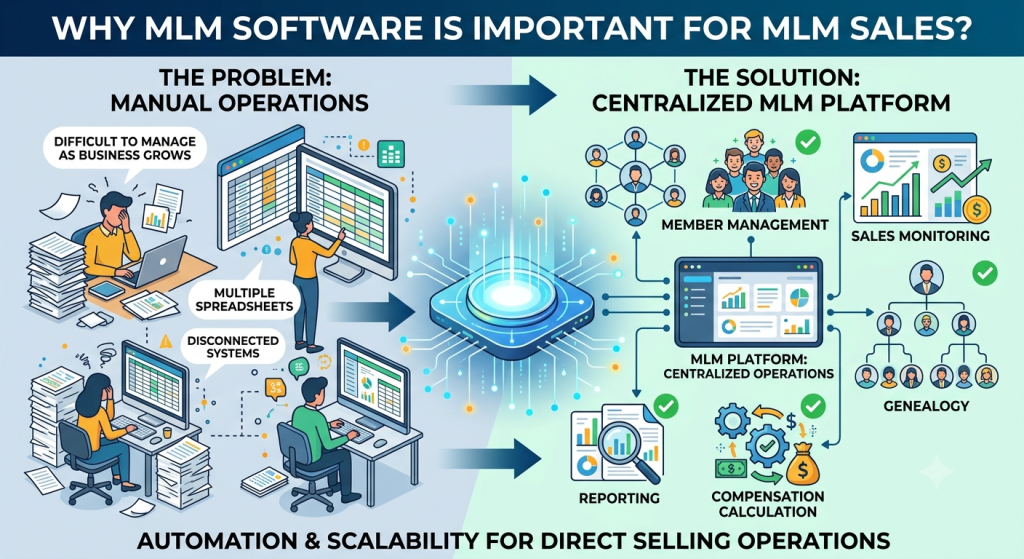
As an MLM business grows, managing operations manually becomes increasingly difficult.
MLM software is designed specifically to manage network marketing and direct-selling operations. Modern platforms can support activities such as member management, sales monitoring, genealogy, compensation calculation, and reporting.
Instead of maintaining multiple spreadsheets and disconnected systems, companies can centralize important operations inside one platform.
Key MLM Software Features for Sales Management
Distributor Management
Create, manage, activate, suspend, and monitor distributor accounts.
Genealogy Management
Display sponsor relationships and organizational structures through a visual genealogy or tree.
Sales Management
Track orders, product purchases, sales volume, customers, and distributor performance.
Commission Management
Automate commission calculations based on the company’s selected compensation plan.
E-Wallet
Allow distributors to view balances, earnings, transactions, and other wallet-related information.
Payout Management
Manage distributor payouts and payment processing workflows.
Rank and Bonus Management
Configure rank requirements, achievement bonuses, leadership incentives, and other performance-based rewards.
Reports and Analytics
Provide administrators with insights into sales, commissions, distributors, orders, and organizational performance.
CRM Integration
Customer relationship management features can help teams organize prospects, customers, communication, and follow-up activity.
Mobile Access
A mobile-friendly platform or MLM mobile app can give distributors access to their sales information and business tools while working remotely.
How Does MLM Software Improve MLM Sales?
MLM software does more than calculate commissions. It can support the entire sales-management process.
For example:
Without MLM software:
Lead → Manual Follow-Up → Order Entry → Spreadsheet → Commission Calculation → Manual Report → Payout
With MLM software:
Lead/Customer → Distributor Dashboard → Order → Sales Tracking → Automated Compensation → Reports → Payout
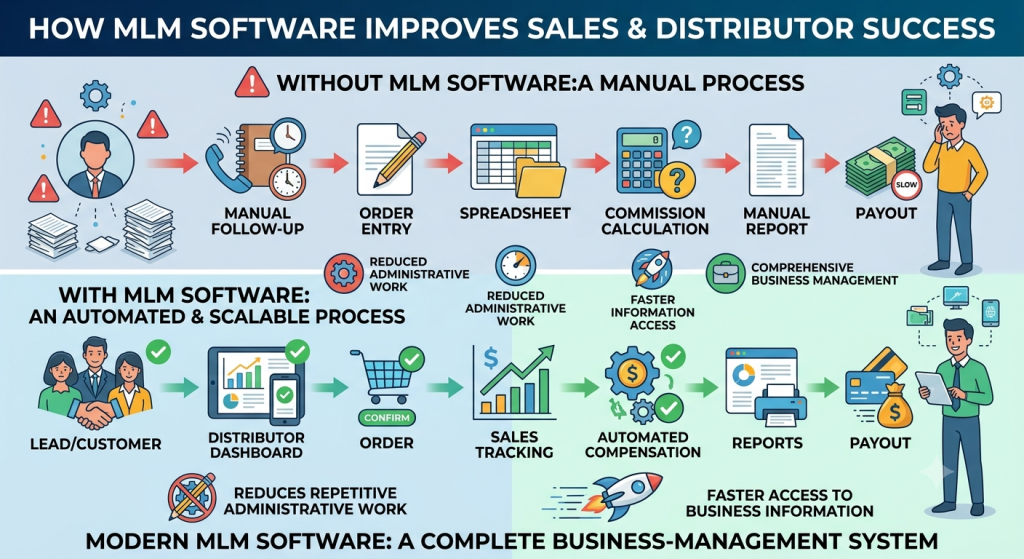
This type of automation can reduce repetitive administrative work and give distributors faster access to business information.
Modern MLM software platforms are increasingly designed as comprehensive business-management systems rather than simple commission calculators.
Best MLM Software for Managing MLM Sales
For companies looking for an integrated platform to manage network marketing operations, Hybrid MLM Software is a strong solution to consider.
Hybrid MLM Software is built for MLM and direct-selling businesses that need to manage distributors, sales, compensation plans, e-commerce operations, customer relationships, wallets, payouts, reports, and other business processes from a centralized platform.
For a growing MLM company, the key advantage is having sales management and compensation management connected within the same system.
Businesses evaluating an MLM platform should look for capabilities such as:
- Multiple compensation plans
- Distributor management
- Genealogy tree
- Sales and order management
- Commission automation
- E-wallet
- Payout management
- CRM integration
- E-commerce integration
- Payment gateway integration
- Multi-language support
- Multi-currency support
- Reports and analytics
- Mobile-friendly distributor access
- Security and role-based administration
The right system should match the company’s compensation model, operational workflow, growth plans, and market requirements rather than simply offering the largest feature list.
How to Choose the Best MLM Sales Software
Before purchasing MLM software, businesses should evaluate several important areas.
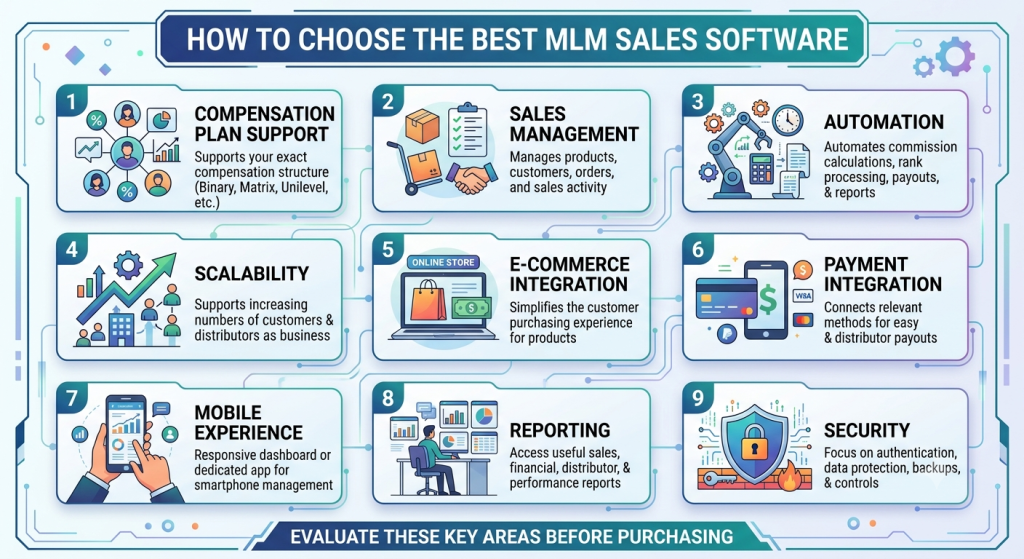
1. Compensation Plan Support
Make sure the platform supports the exact compensation structure your company uses.
2. Sales Management
Check whether the software can manage products, customers, orders, sales volume, and distributor sales activity.
3. Automation
Look for automation in commission calculations, rank processing, payouts, notifications, and reports.
4. Scalability
The platform should be able to support increasing numbers of customers and distributors as the business grows.
5. E-Commerce Integration
Higher-level distributors may receive incentives based on qualifying team performance.
6. Payment Integration
The ability to connect relevant payment methods can make customer purchases and distributor payouts easier to manage.
7. Reporting
Administrators should have access to useful sales, financial, distributor, and performance reports.
8. Mobile Experience
Distributors increasingly expect to manage their business using smartphones. A responsive dashboard or dedicated mobile app can improve accessibility.
9. Security
Because MLM platforms may handle personal, financial, and sales-related information, businesses should pay close attention to authentication, authorization, data protection, backups, and other security controls.
MLM Sales Funnel Example
A simple MLM sales funnel may look like this:
1. Lead Generation
A potential customer discovers a product through social media, referral, an event, website, or distributor.
2. Product Presentation
The distributor explains the product or service.
3. Follow-Up
The prospect receives additional information and answers to questions.
4. Purchase
The customer places an order.
5. Customer Retention
The distributor continues supporting the customer and encourages repeat purchases where appropriate.
6. Referral
Satisfied customers may refer new prospects.
7. Distributor Opportunity
A qualified person may decide to become a distributor.
8. Network Growth
The distributor develops their own customer base and organization.
This process demonstrates why MLM sales is not simply about recruitment. Product sales, customer relationships, retention, and distributor activity are all important components of the overall business model.
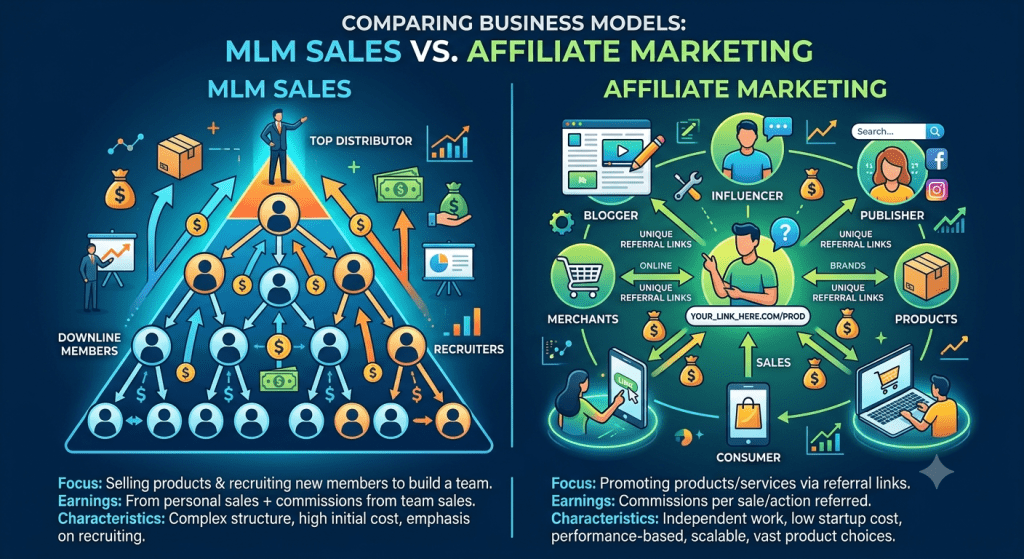
MLM Sales vs Affiliate Marketing
MLM sales and affiliate marketing can appear similar because both may use referral links and performance-based commissions, but their structures can differ.
In affiliate marketing, a publisher or affiliate generally promotes products and receives a commission for qualifying referrals or purchases.
In MLM, a distributor may sell products directly and may also participate in a multi-level distributor structure.
The distinction becomes especially important when analyzing how compensation is calculated, how participants are organized, and whether the business depends on product sales to real customers.
Common MLM Sales Terms You Should Know
If you are new to MLM sales, understanding common terminology can make the industry easier to navigate.
Distributor: A person who sells or promotes the company’s products or services.
Sponsor: The distributor who introduces or sponsors another member into the organization.
Downline: Members who exist below a distributor within the organizational structure.
Upline: Members above a distributor in the organization.
Genealogy: The structural representation of relationships between distributors.
Commission: A payment associated with qualifying sales or other compensation criteria.
Sales Volume: A measurement used by the company to calculate commissions, bonuses, rankings, or qualification.
Rank: A status level within the MLM organization based on defined criteria.
Compensation Plan: The rules used to calculate commissions and incentives.
Frequently Asked Questions About MLM Sales
What is MLM sales in simple words?
MLM sales is a business model where products or services are sold through a network of independent distributors. Distributors may earn from their own qualifying sales and, depending on the compensation plan, from qualifying sales generated within their organization.
Is MLM sales the same as network marketing?
The terms are often used interchangeably. Network marketing commonly refers to selling products or services through a network of independent representatives, while MLM emphasizes the multi-level structure of the organization.
How do MLM distributors make money?
Depending on the company’s compensation plan, distributors may receive commissions or bonuses from qualifying personal sales and potentially from qualifying sales within their organization.
What is an MLM compensation plan?
An MLM compensation plan defines how commissions, bonuses, incentives, ranks, and other rewards are calculated and distributed.
Is MLM software necessary for a small MLM company?
A small business may initially manage some processes manually, but as distributors, customers, orders, and commissions increase, specialized MLM software can help centralize and automate operations.
What is the best MLM software?
The best MLM software depends on the company’s compensation plan, product model, sales process, integrations, budget, scalability needs, and required features. Hybrid MLM Software is one platform businesses can evaluate for managing network marketing operations.
Can MLM software calculate commissions automatically?
Yes. MLM software is commonly designed to automate commission calculations according to configured compensation rules. Modern MLM platforms may also manage genealogy, sales tracking, member accounts, and reporting.
Final Thoughts
MLM sales is a network-based sales model that combines direct product selling with a structured distributor organization. Its success depends on several interconnected factors, including quality products or services, effective sales strategies, customer relationships, distributor engagement, transparent compensation rules, and efficient business management.
As an MLM company grows, technology becomes increasingly important. Managing distributors, customers, orders, sales volume, commissions, payouts, and reports manually can become complex.
This is why choosing the right MLM software can make a major difference.
A modern network marketing platform can help businesses automate repetitive processes, improve sales visibility, simplify commission management, support distributors, and create a more organized operational environment.
For businesses planning to launch or expand a network marketing company, Hybrid MLM Software can be considered as a comprehensive platform for managing MLM sales and related business operations.